
Can India Adopt Brazil's Ethanol Model? Lessons for India's Green Fuel Future
Fuel Strategy · Sugarcane to Cylinder
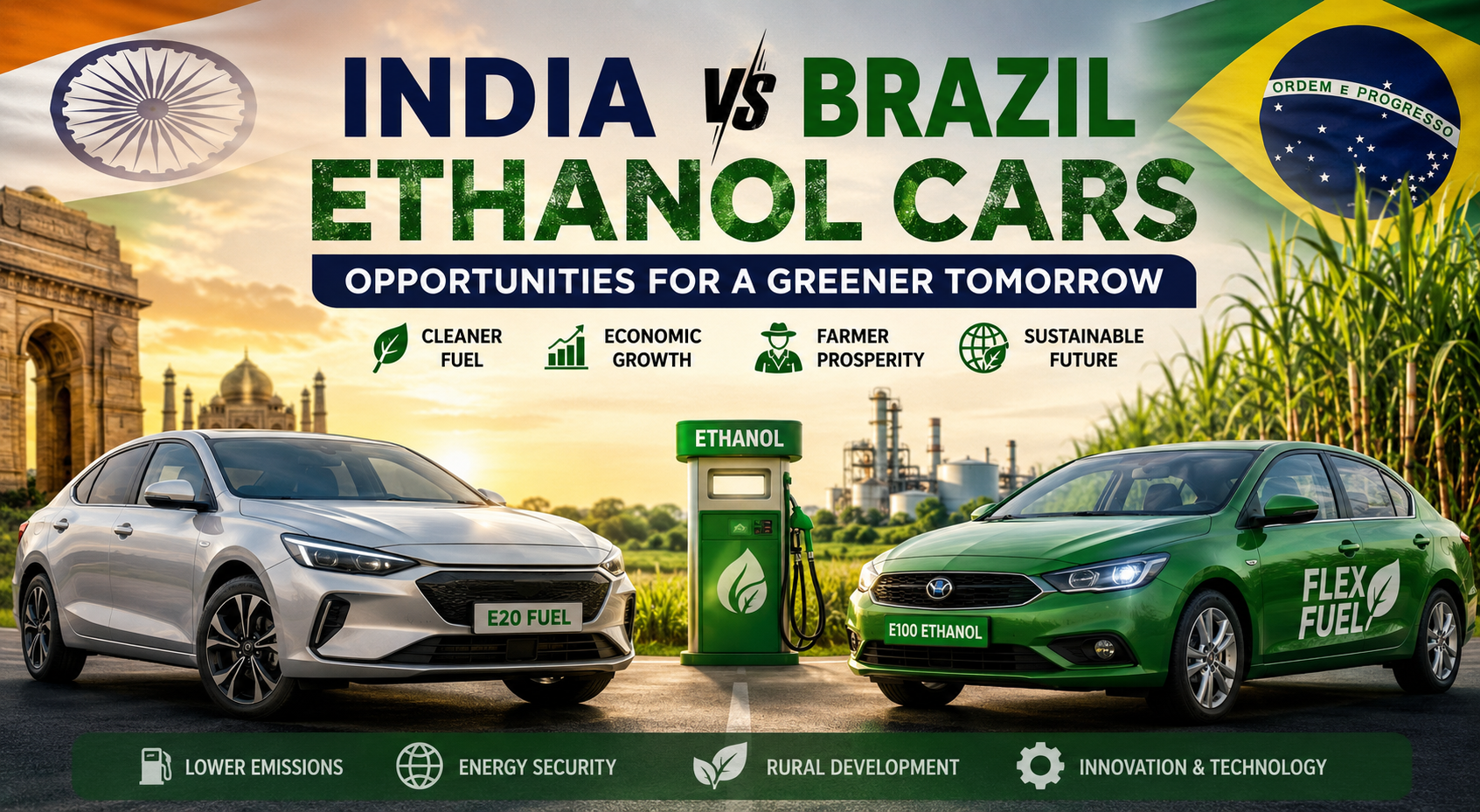
Can India Replicate Brazil’s Ethanol Success?
Brazil spent four decades turning cane fields into a national fuel supply. India is starting the same journey — on different soil, with different crops.
India, today
Brazil, flex-fuel ceiling
As India accelerates its transition toward cleaner transportation, ethanol-powered vehicles have emerged as a promising solution to reduce fuel imports and carbon emissions. Brazil has spent more than four decades developing one of the world’s most successful ethanol ecosystems, where millions of flex-fuel vehicles (FFVs) operate on gasoline, ethanol, or any blend of both. India has already introduced E20 petrol — but can it follow Brazil’s model completely? The answer is yes, with an India-specific strategy.
01 · The Brazilian Model
Why Brazil became the global leader
Brazil transformed its transportation sector through sustained investment: sugarcane-based ethanol production, flex-fuel vehicle technology, nationwide fueling infrastructure, long-term government incentives, and stable biofuel policy. Today, Brazilian drivers can choose between petrol and ethanol at the pump depending on market price — a freedom built on four decades of consistency, not a single policy cycle.
02 · Side by Side
Ecosystem comparison
| Feature | Brazil | India | Opportunity |
|---|---|---|---|
| Primary feedstock | Sugarcane | Sugarcane, maize, rice straw | Multiple feedstocks |
| Fuel blend | E27–E100 | E20 | Expand gradually |
| Vehicle type | Flex-fuel vehicles | Petrol, CNG, EV | Introduce affordable FFVs |
| Oil imports | Low | High | Reduce crude imports |
| Infrastructure | Mature | Developing | Invest in distribution |
| Government support | Strong | Increasing | Accelerate incentives |
03 · The Field Ahead
Ten opportunities for India
Reduce crude oil imports
India imports nearly 85% of its crude oil, leaving fuel prices exposed to global swings. Expanding ethanol use can cut import dependence and strengthen energy security — lowering import bills, improving trade balance, and increasing independence.
Increase farmers’ income
Unlike Brazil, India can draw on sugarcane, maize, damaged food grains, rice and wheat straw, bamboo, and agricultural waste — creating new farmer revenue streams while cutting waste.
Build a flex-fuel manufacturing hub
Maruti Suzuki, Tata, Mahindra, Hyundai, and Toyota could all build affordable FFVs for domestic use and export, positioning India as a global manufacturing hub for ethanol-compatible vehicles.
Create millions of green jobs
The ethanol value chain spans distilleries, logistics, manufacturing, fuel retail, R&D, and agricultural processing — supporting rural development alongside industrial growth.
Improve air quality
Ethanol generally burns cleaner than petrol, cutting carbon monoxide, hydrocarbon, and greenhouse gas emissions — a meaningful lever for urban air quality.
Promote second-generation (2G) ethanol
India produces millions of tonnes of crop residue annually. Converting it to ethanol, instead of burning it, reduces stubble burning, adds farmer income, and builds a waste-to-wealth economy.
Attract foreign investment
Global biofuel players can invest in refineries, research, automotive manufacturing, and green infrastructure — India’s scale makes it an attractive market.
Strengthen rural infrastructure
Ethanol production drives investment in storage, rural transport, processing plants, and supply chains — boosting local economies with durable employment.
Become a biofuel exporter
India can export ethanol production technology, distillery equipment, biofuel engineering services, and flex-fuel components — becoming a global biofuel technology partner.
Support India’s net-zero goals
Wider ethanol adoption lowers transport-sector emissions, reduces fossil fuel dependence, and supports India’s broader climate commitments.
04 · Friction Points
Challenges India must overcome
- —High water consumption in sugarcane cultivation
- —Limited ethanol distribution infrastructure
- —Low consumer awareness of flex-fuel vehicles
- —Higher initial investment requirements
- —Need for affordable FFVs
- —Sustainable feedstock availability
05 · Outlook
Not a copy of Brazil — a parallel path
India has the agricultural base, engineering talent, and automotive manufacturing strength to become one of the world’s leading ethanol economies. Rather than replicating Brazil exactly, India’s route combines E20 expansion, second-generation ethanol, flex-fuel manufacturing, sustainable farming, and advanced biofuel technology — reducing oil imports, creating jobs, strengthening rural economies, and accelerating clean mobility.
FAQ
Frequently asked questions
Can India adopt Brazil’s ethanol car model? +
Yes — but tailored, using multiple feedstocks, expanding E20, promoting flex-fuel vehicles, and investing in second-generation ethanol rather than copying Brazil’s sugarcane-only path.
Why is Brazil successful in ethanol-powered cars? +
Abundant sugarcane, decades of consistent government support, widespread flex-fuel vehicles, and mature fueling infrastructure.
What are flex-fuel vehicles? +
Vehicles that run on petrol, ethanol, or any blend of the two, with no engine modification required.
Can ethanol replace petrol completely in India? +
Not immediately. Ethanol is expected to complement petrol through higher blending and flex-fuel technology as part of a diversified mobility strategy.
Related Articles

Top Technology Trends Transforming Businesses in 2026
Top Technology Trends Transforming Businesses in 2026